
.png)
.png)

.png)


OUR SERVICES
Teeth Whitening
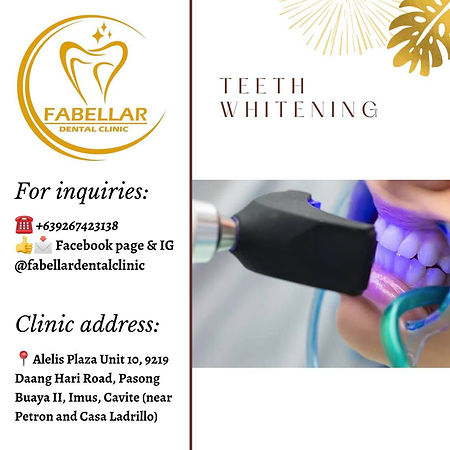
Laser teeth whitening: takes around two hours and produces results instantly. The procedure involves the application of a whitening gel to your teeth and using a laser beam to activate the whitening ingredients in the gel. You will need three applications, usually applied in 20-minute intervals. The dentist will be careful to prepare your mouth so that the gel is only applied to your teeth and not to your soft tissues. Your dentist will furnish you goggles to shield your eyes from the laser.
After the final application, your dentist will remove all traces of the gel and thoroughly clean your teeth before showing you your gleaming white smile.
At-home professional whitening: You will need two visits for this treatment. On the first visit impressions of your teeth are made and sent to the lab, where trays that fit over your teeth will be made. After a few days, you will return to your dentist to pick them up and to be shown how to use them in combination with the gel, which your dentist will give you. You will usually wear the trays overnight and continue the treatment until you are satisfied with the degree of whiteness achieved.
Dental Cleaning
What is professional teeth cleaning?
Professional teeth cleaning also called deep teeth cleaning or prophylaxis is performed to remove plaque and tartar from teeth. It can be performed by a dentist, but often by a certified dental hygienist. It is also done to remove staining from teeth. It is recommended that patients get professional dental cleaning done twice a year for their long term dental and oral health. Professional dental cleaning takes from 30 to 90 minutes, depending on the amount of work that needs to be done.
Is professional teeth cleaning painful?
Patients may experience pain and sensitivity during the teeth cleaning procedure. Hygienists may numb the gums of the patient before cleaning to make the procedure pain free.
What is the recovery time after having teeth professionally cleaned?
Patients who experience pain, sensitivity or bleeding after professional teeth cleaning usually recover within a few days.
What are the types of professional teeth cleaning procedures?
The types of professional dental cleaning include general dental cleaning, scaling and polishing, air abrasion, cleaning using ultrasonic scalers and laser assisted dental cleaning.
What care is required after professional teeth cleaning?
Patients should take any medications prescribed by the dentist correctly. They should rinse their mouths with warm salt water after every meal for at least two weeks. They should be wary of hard food or food that may stick between teeth. If they experience sensitivity, they should not eat or drink very hot or very cold food till the sensitivity abates.
Polishing & Stain Removal
Tooth polishing is a procedure which not only polishes the teeth but also removes the dental stains, plaque, and microorganisms formed on the outer surface of the teeth.
The main advantage of tooth polishing over the tooth scaling (deep cleaning of the teeth) is that it is a painless procedure. Also, patients experience clean and smooth teeth instantaneously after the procedure.
Types of Tooth Polishing
-
Therapeutic polishing - Many a times during a dental surgical procedure, the cementum covering the root is exposed. Therapeutic polishing assists in the removal of any microflora and endotoxins from the surface of cementum.
-
Coronal / cosmetic polishing - This type of polishing removes the plaque and superficial dental stains. Superfine abrasive agents are used to make the enamel (outer layer covering the crown of the tooth) lustrous. Enamel surface is polished to an extent that it can even reflect the visible light.
-
Superficial polishing - This technique polishes the crown of the tooth. However, this technique has nominal curative benefits, and is primarily done to improve the aesthetic appearance of the teeth.
-
Selective polishing - Selective polishing is also termed as extrinsic stain removal or selective stain removal. This polishing technique is recommended post scaling procedure, and it removes any remaining stains.
Fluoride Treatments
Fluoride Therapy is an oral health care for tooth decay which can be applied topically or systemically. It is the process of delivering enough fluoride to the teeth to prevent tooth decay.
Fluoride is a mineral formed in your teeth from daily consumption of food and water. The minerals are accumulated in the tooth’s enamel which causes tooth cavities.
In topical medication, the dentist directly applies fluoride to the different forms such as gels or varnishes. Systemic treatment is done through the intake of fluoride supplements.
Supplements of fluoride are highly recommended as they have the ability to effectively preventing tooth decay. Hence, the treatment, by proving fluoride supplements, is a big key to good oral health as it adds much needed extra protection for your teeth. That’s why Fluoride Therapy is highly recommended for both children and adults.
Commonly practiced by dentists, Fluoride Therapy is medically recognized as being one of the most useful treatments in the modern dental field since fluoride fights off the formation of tooth decay in various ways.
Benefits Of Fluoride Treatment
-
It minimizes the possibility of decay and strengthens teeth
-
It makes teeth more resistant to acid attacks
-
It reverses the early process of decay
-
It is necessary for growing children whose permanent teeth have started to emerge
-
It speeds up the process of remineralization to repair tooth enamel
-
It is important for adults who have orthodontic devices such as braces and crowns







.png)
You deserve the extraordinary
